Piping Visitor Page-View Sequences Into an N8n AI Agent Node
Feed visitor sequences, not single page views, into AI reasoning to qualify intent accurately.
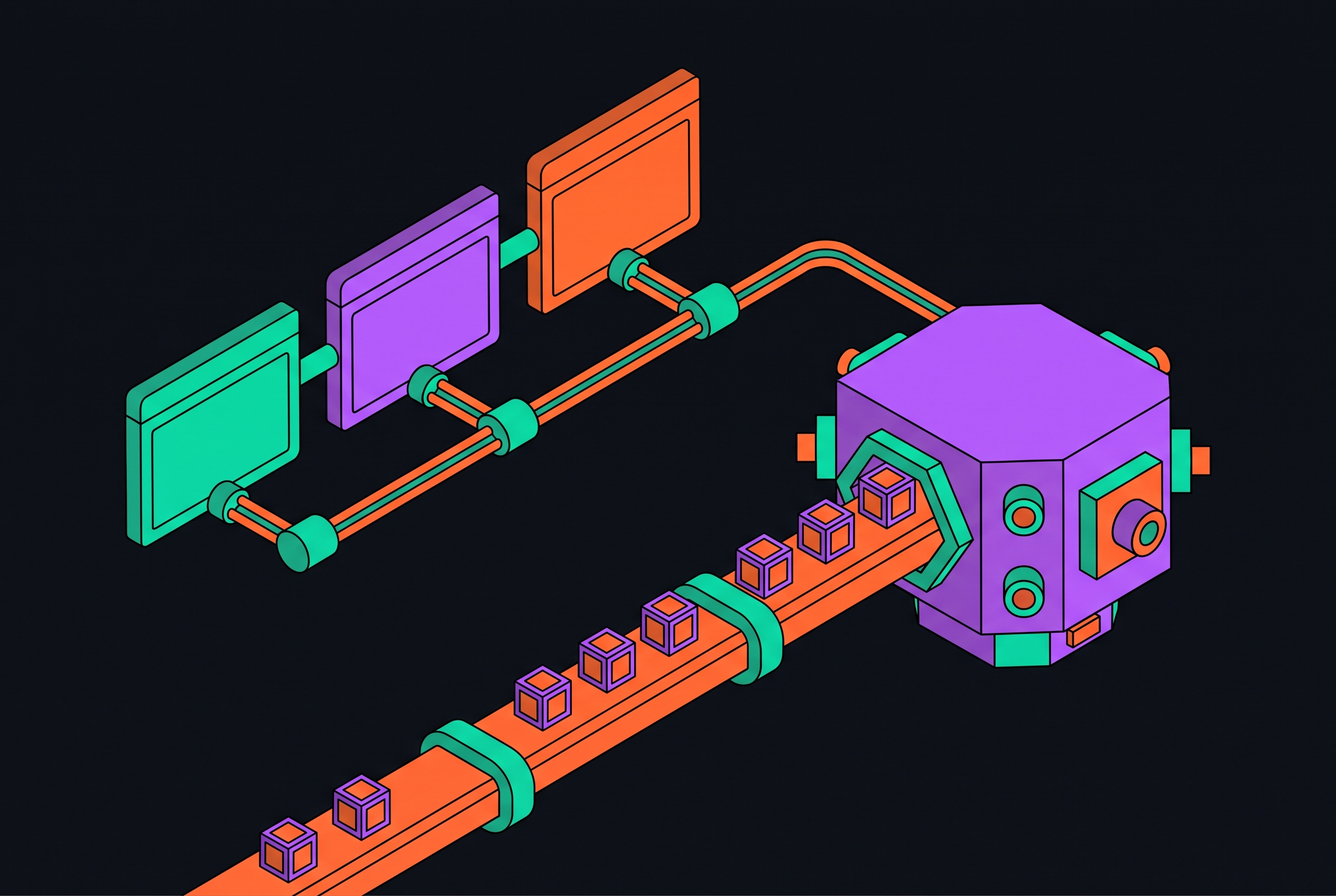
A single page view tells a demand-gen team almost nothing about buying intent, so this article shows you how to fix that by feeding entire visit sequences, not isolated hits, into an n8n AI Agent node that reasons over behavioral context before acting. In a conventional single-event webhook alert, those two visitors look the same, because the alert fires on the first page view and has no mechanism for weighing what happened before or after it. The fix is architectural. Accumulate the sequenced page-view events for a session, then pass the full sequence as context to a reasoning layer, which is exactly the kind of structured input the n8n AI Agent node was built to accept.
The n8n AI Agent node's role in this workflow
As of May 2026, n8n ships an AI Agent node that wraps LangChain primitives (tools, memory, and output parsers) inside its standard workflow canvas. That packaging matters because it means the node can reason over structured input, such as a visitor's page-view sequence, and decide on its own which downstream tool to invoke in response. The node takes three kinds of configuration: a chat model, an optional vector store, and a list of tools, where each tool is itself an n8n sub-workflow or an HTTP request. Inside, it runs a function-calling loop built on ReAct principles, and it works through reasoning and action steps until the model either emits a stop signal or hits a configurable step cap.
The practical consequence of this design is that nobody hard-codes which tool the agent uses for a given visitor. A system prompt describes the agent's qualification goal, and the model reasons about which tool to call and in what order, rather than following a fixed branching tree of if-then conditions. As of May 2026, the node supports a wide range of model providers, including OpenAI, Anthropic, Mistral Cloud, Google Gemini, Google Vertex AI, Ollama for local models, Groq, DeepSeek, Azure AI Foundry, AWS Bedrock, Cohere, xAI Grok, and OpenRouter, among others. Because any of n8n's 400-plus integrations can become a tool for the agent, CRM writes, Slack messages, and ad-platform audience updates are all reachable without writing a provider SDK by hand. That architecture is the real departure from a static branching workflow: the agent decides what action to take based on the content of its input, including a page-view sequence.
Of the three, Postgres Chat Memory is the pattern suited to accumulating visitor sessions over time, since it persists state in a durable store rather than holding it only in the execution's working memory.
Capturing the page-view sequence: what to fire, when, and in what shape
Everything downstream depends on the quality of the event stream captured at the start, and that stream needs four fields on every hit: the URL, a timestamp, a session ID, and a visitor identity token. Session ID does the real structural work here: it is what groups individual page-view events into a sequence, and without it the agent receives nothing more than an unordered bag of URLs rather than a behavioral narrative it can reason over.
Keep the payload itself lightweight at capture time. Two decisions shape this stage. The second is what session window to use, time-based with a 30-minute idle timeout being the conventional choice, or navigation-based, closing the session when the visitor's path breaks in a defined way.
Events need somewhere to live before the agent ever sees them. An n8n Code node can aggregate incoming events into a Postgres table keyed by session ID, and it holds the sequence open until the session closes naturally or a trigger condition fires. Some visitor tracking layers remove this step. If you run on that layer, you can skip the bare-token approach described above and pipe already-enriched sequences directly into the pipeline, with identity resolved at the moment of capture.
Filtering bot and AI agent traffic before it reaches the reasoning layer
If you don't separate automated traffic out before enrichment and reasoning happen, a visitor pipeline that feeds an AI agent will generate false positives. AI-driven and automated traffic makes up a fast-growing share of total web traffic, and most of it does not self-identify correctly in HTTP headers. The problem won't announce itself in the data the way a malformed field would. Standard analytics tools categorize headless browser traffic as real visitors by default, because they have no way to distinguish a genuine prospect from a Playwright or Puppeteer script running inside a real browser engine.
Reliable detection depends on layering several signal families. Identity signals come from HTTP headers and TLS fingerprints. Browser signals come from JavaScript-observable device properties, and behavioral signals come from mouse, keystroke, and navigation patterns. Tools like Fingerprint, with AI Assistant Detection deployable at the CDN edge, in middleware, or on any backend, and cside, which performs browser-layer behavioral fingerprinting combining cursor dynamics, canvas rendering, and session-timing analysis, address different layers of this stack; analytics platforms such as Matomo have built dedicated reporting for AI chatbot and AI agent traffic inside their AI Assistants category, reflecting how mainstream this contamination risk has become.
In the n8n pipeline itself, you place the bot gate as an HTTP Request tool node right after the webhook trigger. It calls a detection API, gets back a confidence score, and routes any session above the bot threshold to a separate agent-traffic branch, excluding it from the human-visitor enrichment queue. That placement matters: the gate has to run before enrichment spend and before the AI Agent node ever sees the session, or the pipeline ends up reasoning over, and acting on, contaminated data.
Enriching the session: resolving company and person identity against the accumulated sequence
Enrichment is what turns an anonymous session fingerprint into a structured identity record, company name, firmographics, and where available a named contact with title, LinkedIn profile, and work email, giving the agent something concrete to qualify against the accumulated sequence built in the previous steps. This call belongs after bot gating and before the agent receives its payload. Spending enrichment credits on traffic that turned out to be automated is wasted spend, and handing the agent an anonymous record when a named one was available undercuts the entire point of the pipeline.
Company-level identification, meaning organization, industry, and size, carries a meaningfully higher realistic match rate on B2B traffic than person-level identification, meaning name, title, email, and LinkedIn. That gap has a regulatory dimension as well as a technical one: person-level tracking falls under GDPR, CCPA, and a growing list of state privacy laws, and most B2B teams find that company-level identification alone is sufficient to qualify intent while carrying substantially lower regulatory risk.
In the n8n workflow, enrichment runs as a Tool node, or in some builds an HTTP Request node, that takes the session's IP address or fingerprint token, calls an enrichment provider, and writes the returned record into the payload headed for the AI Agent node. One confirmed production pattern illustrates the shape of this well: a workflow triggered by a new Salesforce lead calls an enrichment API such as ZoomInfo, writes the enriched fields back to the Salesforce record, evaluates routing rules against those fields, posts a Slack notification, and creates a follow-up task, all inside a single n8n execution. As with capture, some platforms collapse this step. Maverick Intelligence performs this enrichment natively, resolving name, company, title, LinkedIn, and email on every identified visit, so teams using it can pass an already-enriched visitor object straight into the agent node without running a separate enrichment call.
Structuring the agent's input: how to format the enriched sequence for the system prompt
The AI Agent node reasons only over what its system prompt and user message actually contain, so the shape of the visitor payload is what determines the quality of every qualification decision that follows. Say a fictional visiting company has a contact who opens the pricing page, then the integration docs, then the HubSpot integration page, all in one session. A visitor identity block holds company name, industry, size, contact name where resolved, title, LinkedIn URL, and email. An attribution context block states whether the visiting company had a LinkedIn Ads or Google Ads impression or click within a defined lookback window, so the agent can weight its qualification score accordingly. A page-view sequence block lists, in order, the pages visited with ISO timestamps and time-on-page where available, running from session open to session close or to whatever event triggered the agent. Session metadata closes the payload: session ID, total pages viewed, session duration, and entry source.
The system prompt carries the qualification logic itself, and it should state that logic explicitly rather than leaving it implicit: which page combinations signal high intent (pricing plus integration docs plus a case study in a single session, for instance), which firmographics match the ideal customer profile, and what action each combination should trigger. For the sequence block specifically, a simple numbered list of entries in the form "timestamp, URL, time on page" is more reliable than a prose summary at this stage, because the model parses ordered lists consistently while prose introduces ambiguity about order and duration that can change the qualification outcome.
The node's max iterations parameter, which defaults to 10, hard-caps the ReAct loop, and it should be set deliberately based on how many tool calls the agent actually needs to complete its qualification and routing logic for a given use case. On the question of scope, pass only the current session's pages into the prompt unless cross-session reasoning is a deliberate design choice; if it is, that reasoning belongs in a Postgres-backed memory layer, not stuffed into the prompt payload itself.
Defining the agent's tools
An agent that only classifies a visitor without acting on that classification produces a label, not a result. The tools available to it decide whether the pipeline produces pipeline. A visitor-qualification agent needs four core tools. A CRM write tool creates or updates a contact or company record in HubSpot or Salesforce with the enriched visitor data and a qualification score; n8n's HubSpot connector delivers 18 real-time trigger events and 31 action operations across contacts, companies, deals, and tickets, while the Salesforce integration supports native CRUD operations alongside SOQL queries for more targeted record selection. An ad-platform audience tool pipes high-intent identified visitors into a LinkedIn Matched Audience list through the LinkedIn Marketing API, supporting ABM retargeting or suppression of visitors who have already converted; LinkedIn Lead Gen Forms pre-fill professional data from user profiles for these same matched audiences. If the agent judges a visitor low-intent, already a customer, or a known competitor, a suppression tool just logs the session and exits without alerting anyone.
The agent chooses among these tools based on its own reasoning over the qualification criteria in its system prompt. If a named ICP contact has visited pricing, integration docs, and a case study inside one session, they get the CRM write plus the Slack alert. Attribution context shapes this decision further: if the visiting company had an ad impression or click within the lookback window, the agent can weight its score upward and trigger a different outreach sequence. Adobe Marketo Measure, formerly known as Bizible, offers a unified attribution model spanning paid, organic, email, events, and offline interactions, with deep Salesforce integration suited to enterprise ABM programs. Platforms like Maverick Intelligence, with native HubSpot, Salesforce, Slack, and ad-platform integrations, serve as both a natural source for the enriched visitor object and a natural destination for the agent's CRM-write and audience-update calls, closing the pipeline without requiring a custom API wrapper for each endpoint.
Adding a human-approval gate for irreversible actions
Some actions should never run on full autopilot. Sending an external email, modifying a live CRM record, or updating a paid-media audience are irreversible enough that the agent should prepare the action and pause for a human to confirm it. n8n's Wait node is the mechanism: the agent prepares the action, the Wait node halts execution, a human approves or rejects the action through a webhook, and the workflow continues or exits based on that response.
Slack makes the most ergonomic approval surface for this pattern. Not every action warrants this gate. CRM reads, Slack posts to internal channels, and the qualification scoring itself do not need one.
The n8n Execution Log records every tool call, model output, and piece of intermediate state along the way. If you pair that log with Langfuse or Helicone through the HTTP Request node, you get a per-session trace that includes token cost, latency, and tool error rates, so you can audit after the fact what the agent approved or suppressed.
Operational failure modes in production
Three failure modes dominate agent workloads once they reach production: model timeouts, tool errors, and runaway token spend. Each needs a deliberate mitigation built in at design time.
Model timeouts tend to surface when the agent reasons over dense page-view sequences, because long-running model calls can exceed cloud execution time limits.
Tool errors inherit n8n's standard retry policy, which uses a fixed wait time with a configurable maximum number of attempts rather than exponential backoff; true exponential backoff requires building a custom loop with Wait and Code nodes. Error branches need to be designed explicitly for each tool, and the CRM write and ad-platform audience update tools deserve particular attention here, since they fail in distinct ways: auth expiry, rate limits, and schema mismatches each require different handling.
Token cost is the least visible of the three: n8n does not show you per-execution LLM cost in its interface, so an agent node that retries tool calls can quietly multiply spend on a workflow that looked cheap during testing. Instrumenting the pipeline with Langfuse or Helicone gives per-session visibility into token cost, latency, and error rates, and that visibility belongs in place before the workflow reaches production volume, not after.