Streaming Maverick Visitor Events Into a Data Warehouse
Filter human traffic from bots before it reaches your warehouse.
Feeding a warehouse directly from a raw visitor event stream means feeding it a mix of signals that were never meant to sit in the same table. Most teams treat this as a storage problem: which warehouse to buy, how to shape the schema, how to speed up the query layer. But the failure that actually corrupts a data asset happens earlier, at the point where traffic first enters the pipe. A raw event stream from a modern B2B website carries at least three distinct types of visitors: real human buyers, bots that announce themselves, and automated traffic that doesn't. These three behave in completely different ways, and folding them into a single fact table produces a warehouse that lies in three directions at once. It inflates session counts, it deflates true conversion rates, and it hands paid media credit to clicks that no human made. Every attribution report and every lead score built on top of that table inherits the distortion, and because the error sits in the foundation rather than in a query, it tends to go unnoticed until the numbers stop making sense. Fixing this after the fact, with cleanup scripts and filtered views, treats a symptom. The actual fix happens before ingestion: the pipeline has to separate these signal types as they arrive, because the architecture of that separation, not the choice of warehouse vendor, makes the resulting data asset trustworthy.
Traffic types: human buyers, declared bots, and masquerading AI agents
Three categories of traffic arrive at a B2B website, and each needs its own handling path before it gets written to disk. The first is the human buyer session: anonymous when it first lands, but capable of being identified through enrichment, and carrying real purchase intent. This is the signal the warehouse exists to capture, and everything downstream, from attribution to lead scoring, depends on isolating it cleanly.
The second category is declared bot traffic: crawlers and agents that identify themselves with a known user-agent string and generally follow robots.txt. Training crawlers like GPTBot and ClaudeBot fall into this group, as do search-and-retrieval crawlers such as OAI-SearchBot and PerplexityBot, along with user-triggered fetchers like ChatGPT-User and Claude-User. Because these agents announce what they are, they can be filtered out at the edge with a high degree of confidence, and most teams already do this reasonably well.
The third category is the one that causes the damage: automated traffic that presents itself as an ordinary browser session. It rotates through residential IP addresses, it spoofs standard browser user-agent strings, and it skips robots.txt, since nothing requires it to follow that protocol. At the header level, this traffic looks exactly like a human visitor. It is the category most pipelines fail to catch, and it does the most damage to warehouse integrity, because it gets counted as a real session, scored as a real lead, and credited to whatever ad campaign happened to bring it in.
The scale of this problem deserves attention. Research across a large sample of AI crawler traffic found that a meaningful share of requests presenting a known AI crawler user-agent were spoofed. That means the declared category, the one assumed to be safely filterable, also carries noise that needs to be checked before it is trusted. If a warehouse schema doesn't separate these three traffic types from the start, it will need expensive, retroactive cleanup once someone finally notices the contamination in the downstream reports.
Standard bot-detection controls and the hardest category of automated traffic
The controls most teams already run, user-agent filtering, robots.txt compliance checks, rate limiting at the edge, catch the bots that choose to identify themselves. They do almost nothing against the traffic that doesn't. User-agent filtering only works if the client tells the truth about what it is, and masquerading automated traffic is built specifically to avoid doing that. robots.txt carries no enforcement mechanism at all; it's a voluntary signal, and an agent that ignores it faces no consequence detectable through the protocol itself.
Edge-layer security vendors handle a different problem well: high-volume, low-sophistication attacks, known bad IP ranges, obvious volumetric spikes. Session-level behavioral analysis sits outside what these tools are built to do. Catching the masquerading category requires combining four separate kinds of signal: identity signals pulled from HTTP headers and TLS fingerprints, network signals from ASN data and IP reputation, browser signals drawn from JavaScript-observable device properties, and behavioral signals built from mouse movement, keystroke timing, and navigation patterns. No single control layer, not the firewall, not the CDN, not a basic bot-blocking rule, covers all four at once.
This has a direct consequence for how the pipeline has to be built. Bot classification can't live solely at the edge as a one-time firewall decision made before the request even reaches the application. Behavioral scoring needs to run inside the event-processing layer itself, so that a classification verdict gets attached to each session as a field on the event record before that record ever reaches the warehouse.
The enrichment layer: how human sessions become identified buyer records
Once a session has been validated as genuinely human, it still arrives as an anonymous combination of an IP address and a page view. Enrichment is the step that turns that anonymous record into an identifiable buyer signal, one that carries a name, a company, a title, a LinkedIn profile, and an email address, the exact fields that attribution and lead scoring depend on.
This enrichment work happens in layers, each one adding resolution. Reverse IP lookup establishes which company the session likely came from. Firmographic enrichment adds industry, headcount, and location on top of that. Identity-graph resolution goes further still: it links the session to a specific person, along with contact details for that person.
Reverse IP lookup can name the company behind a session, but only for the minority of traffic that happens to route through IP ranges mapped to a known employer. That share keeps shrinking as more employees work remotely or in hybrid arrangements, routing their traffic through home internet connections that resolve to a consumer ISP. IP lookup alone has no way to see through that gap.
Modern enrichment tools close part of this gap by layering additional signals on top of IP matching: first-party cookies, device fingerprinting, email pixel matching, and identity-graph cross-referencing. Each additional layer picks up sessions that IP matching alone would have missed. Platforms such as ZoomInfo apply this logic through waterfall enrichment inside GTM Studio: they query a proprietary database first, then run additional providers in parallel to fill whatever gaps remain, which raises both match rate and confidence, and you never have to manually manage which provider gets queried first.
For the warehouse schema itself, enrichment output belongs in separate fields attached to the original session event, not written over it. If you keep the raw signal intact alongside the enriched version, you can query the enriched data for scoring and attribution while the original record stays available for audit.
The streaming pipeline architecture: separating, classifying, and routing events before ingestion
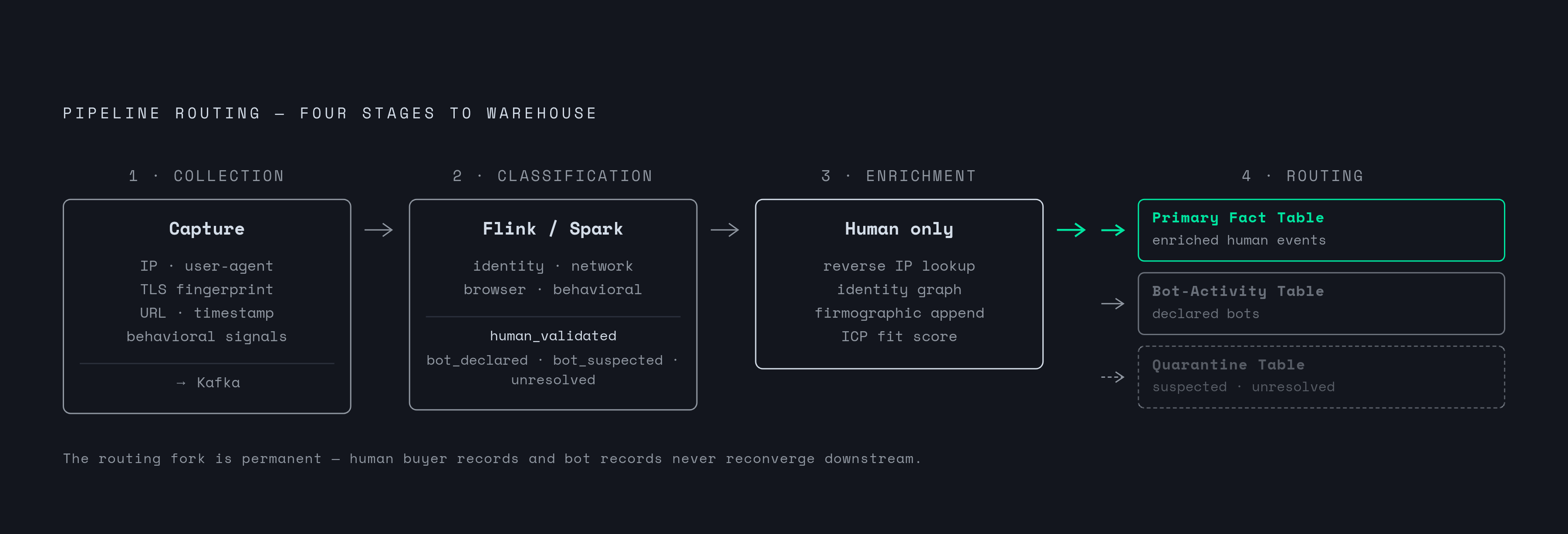
Every event has to pass through a classification-and-routing decision before it reaches the warehouse, so that human buyer records, declared bot records, and suspect records land in three separate tables from the start rather than getting mixed together and sorted out later.
The process starts at the collection layer, where a JavaScript tracking snippet captures raw events, IP address, user-agent string, TLS fingerprint, page URL, timestamp, behavioral data, and sends them to an event streaming platform such as Apache Kafka or a managed equivalent. At this point, all three traffic types are present in the stream and nothing has separated them yet.
From there, events move into the classification layer, where a stream-processing job built on Flink, Spark Streaming, or a managed equivalent applies the four-signal detection logic described earlier: identity, network, browser, and behavioral. Each event gets tagged with a classification field, human_validated, bot_declared, bot_suspected, or unresolved, and that tag stays attached to the event for the rest of its path through the pipeline.
Events tagged human_validated then move into the enrichment layer, where the identity service runs reverse IP lookup, identity-graph resolution, and firmographic append, merging name, company, title, LinkedIn, email, and ICP fit score into the event record before it exits processing.
The routing layer makes the final decision on where each record lands. Enriched human events go to the primary fact table in the warehouse. Declared bot events go to a separate bot-activity table, which is useful on its own terms for AI-crawler intelligence and content consumption analysis. Suspected events go to a quarantine table for further review. So the primary fact table never receives a record that hasn't been classified.
On the warehouse side, the details matter less than the discipline that got the data there clean. Processed, classified events can be written to object storage such as S3 or GCS in a columnar format like Parquet or ORC for efficient batch reads. From there, the cleaned stream can flow into Snowflake through Snowpipe or Snowpipe Streaming, into BigQuery through the Storage Write API for sub-minute analytics, or into Redshift through Kinesis or MSK with materialized views for near-real-time reporting. Each of these paths supports the pipeline; none of them substitutes for it.
The slowest part of this system usually isn't the warehouse's query speed, but the extraction frequency from upstream ad platforms, which typically impose a lag of one to several hours due to attribution windows and fraud detection processing. That constraint doesn't undermine the architecture described here, because visitor enrichment and bot classification run independently of ad-platform data and don't wait on it.
Maverick Intelligence's real-time event model sits naturally at the enrichment and routing stage of this design. It delivers enriched human events and bot or AI-crawler events as separate, structured streams. Much of the classification and routing work has already happened by the time the event reaches whoever is operating the warehouse pipeline.
The bot-activity table as a separate intelligence asset, not just a discard bin
Traffic routed to the bot-activity table is a record of which content AI systems are indexing, training on, and surfacing to their own users, and that record carries its own strategic value separate from anything in the human-session table.
Search-and-retrieval crawlers like OAI-SearchBot and PerplexityBot show which content is getting indexed for AI-driven search results, a distribution channel growing on its own terms, independent of traditional organic search rankings. User-triggered fetchers like ChatGPT-User and Claude-User mean something different: a specific human instructed an AI assistant to go fetch that content on their behalf. That's the closest available proxy for AI-mediated buyer research, and it functions as a weak but genuine buyer-intent signal, one worth joining back to the human-session fact table whenever the same company or IP shows up in both.
A properly structured bot-activity table lets a team ask questions that matter: which AI systems are consuming the site's content, how often, on which specific pages, and whether those pages line up with the pages that human buyers from the same accounts visit later. Maverick Intelligence detects and reports on AI agents, covering both declared crawlers and the behavioral fingerprints of undeclared automated clients, and delivers this as a named, structured stream rather than leaving the detection logic for the pipeline operator to build from scratch.
The clean warehouse as attribution and lead-scoring foundation for downstream GTM tools
If a warehouse strips bot contamination from its human-buyer table and fully enriches it with identity and firmographic data, that is what multi-touch attribution and real lead scoring actually need to function.
The gap this closes is a familiar one in B2B: most visitors never fill out a form. They research, compare options, and leave without identifying themselves. Standard analytics platforms attribute these sessions to a channel but attach no identity to them. CPA and ROAS decisions end up based only on the small slice of visitors who converted, a slice that may not represent the broader buying population.
With enriched, identity-attached session records sitting in the warehouse, every touchpoint a known account built up before converting, a paid ad click, an organic page view, a return visit to the pricing page, can be joined to that account's CRM record. That join is what makes multi-touch attribution possible: it models the full influence path rather than crediting whichever channel happened to touch the deal last.
B2B purchase cycles typically involve a long sequence of touchpoints, but last-touch attribution remains common practice across B2B teams. The warehouse structure described in the previous sections is what makes a shift to multi-touch technically workable, without someone manually stitching together CSV exports from disconnected systems.
Lead scoring built from this warehouse gains two things it cannot get from raw, mixed-signal data. The scores reflect only validated human sessions, so bot inflation disappears from the math. And the scores carry firmographic and identity context, ICP fit, company size, title seniority, that a purely behavioral score has no way to capture.
The same logic extends to paid media. Feeding ICP-fit visitor records back into ad platforms as optimization signals requires identity attached at the person level or at minimum the company level, and the enrichment layer upstream makes that attachment possible. The warehouse is what makes it queryable and auditable once it exists. LinkedIn's Conversions API lets advertisers connect session and CRM data to campaign activity, including actions that happen after the visitor leaves the website. A warehouse built on enriched, identity-attached visitor records is what makes that connection dependable.
Routing enriched warehouse records into CRM and go-to-market tools for downstream activation
None of this architecture produces value by sitting in storage. The warehouse earns its keep by routing enriched records, in near-real time, into the CRM systems, alerting tools, and ad-platform integrations where sales and demand-gen teams actually act on them.
HubSpot typically owns marketing activity in dual-CRM stacks: email engagement, form submissions, page views, campaign source, nurture status. Enriched visitor records from the warehouse flow into HubSpot's contact and company records through its API or a native integration, and this can trigger sequence enrollment or update lead scores on its own. HubSpot's 2026 Developer Platform, released as version 2026.03, introduced new serverless functions and moved to date-based API versioning, replacing the semantic v1 through v4 versioning scheme that older integrations had depended on, and any team maintaining a direct API connection should track this shift.
Salesforce, by contrast, tends to own sales data in enterprise stacks: account owner, opportunity stage, deal amount, close date. If you join enriched visitor events to existing Salesforce account records, sales reps get a live view of account engagement without having to leave the CRM to find it.
Slack alerting adds a timing advantage. A real-time notification triggered by a high-intent event, an ICP-fit account visiting the pricing page for the second time, puts an actionable signal in front of a sales rep while intent is highest, before that session even ends.
Ad platforms close the loop. If you feed identified visitor records back into Google Ads and LinkedIn as custom audiences or optimization signals, those platforms can optimize toward qualified accounts instead of cheap, low-quality clicks. LinkedIn's Matched Audiences and Conversions API support this at both the company level and the person level.
The architecture described across this piece produces a single, auditable intelligence layer: every enriched human buyer event moves from collection through classification and enrichment into the warehouse, then out to the tools where revenue decisions actually get made. Bot and AI-agent activity sits apart from all of it, stored as its own intelligence asset rather than left to contaminate the signal the rest of the business depends on.